


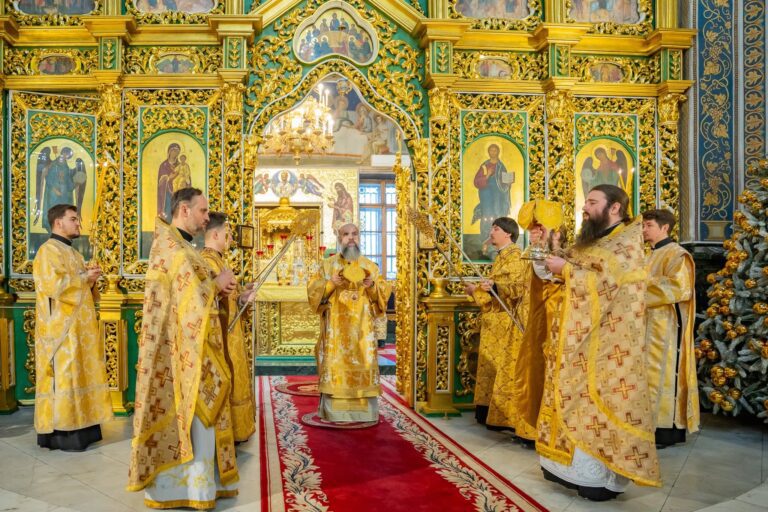
On the 29th Sunday after Pentecost, with the blessing of the Primate of the Orthodox Church of Moldova, His Eminence Metropolitan Vladimir, His Grace Bishop Siluan of Orhei, Metropolitan Vicar, celebrated the Holy and Divine Liturgy at the Metropolitan Cathedral of the Nativity of the Lord in Chișinău. The Cathedral clergy assisted His Grace at the service.
The Gospel reading on the 29th Sunday after Pentecost (Luke 14:16–24), the Parable of those invited to the supper, naturally fits within the spiritual atmosphere of the preparatory period for the great Feast of the Nativity of the Lord. Through this parable, the Saviour reveals the image of God as the Master of the House, who calls people to the great supper, that is, to living communion with Him. The call is universal and ever-present, yet the response remains a matter of human freedom.
Those who are invited refuse the invitation not because of a lack of food, but because of an excess of concerns. Some are bound by possessions, others by pleasures or family obligations—things that are natural in themselves, yet become obstacles when placed before God. Thus, the parable does not condemn work or the responsibilities of life, but highlights the danger of absolutising them when they distance us from our encounter with God.
God does not call us so that we might bring Him something, but so that He may give us everything: grace, strength, enlightenment, and life. The supper to which we are invited is the eucharistic life of the Church, in which Christ Himself offers Himself to humanity as nourishment unto eternal life. Saint John Chrysostom calls the Divine Liturgy the “banquet of faith”, the place where heaven is opened and God bows down to humanity, honouring it beyond all measure.
In the homily delivered during the Divine Liturgy, His Grace Bishop Siluan emphasised that this parable reveals to us the mystery of God’s call to His Kingdom, which flows from His boundless love for humanity. God created us out of love, and out of the same love He sent His Son to sacrifice Himself for our salvation. Our response to this love is made concrete through living participation in the eucharistic supper. To come to the Divine Liturgy and to partake of the Body and Blood of the Lord means to say “yes” to our encounter with God and to taste, even now, the joy of His Kingdom, promised to the Apostles at the Last Supper.
The Parable of those invited to the supper remains a living and personal call for each of us: not to postpone our meeting with God and not to exchange eternal joy for fleeting things. Our free response to His invitation determines the way we live here and the hope we carry for the life to come.
Source: https://manastireacurchi.md/